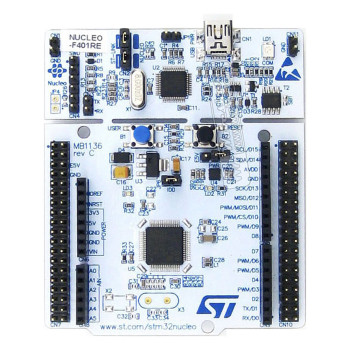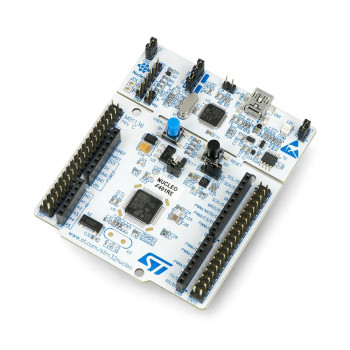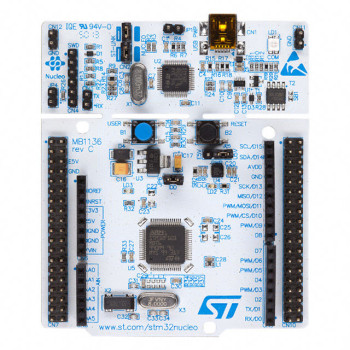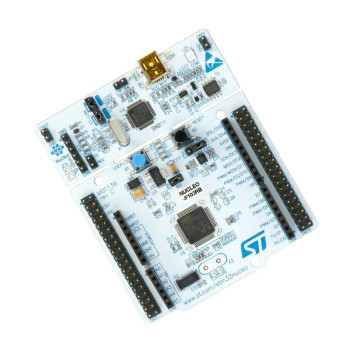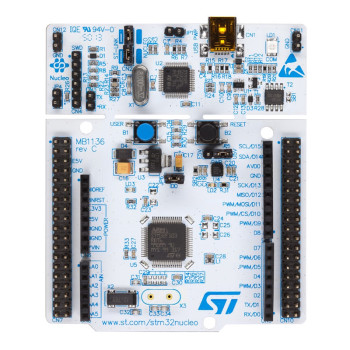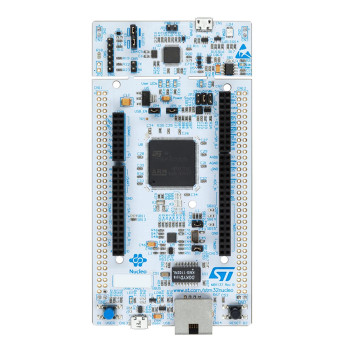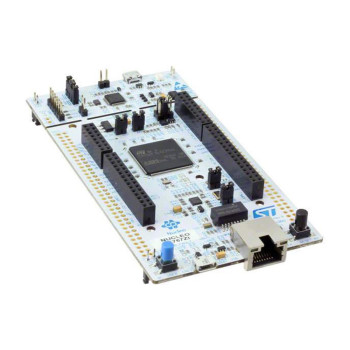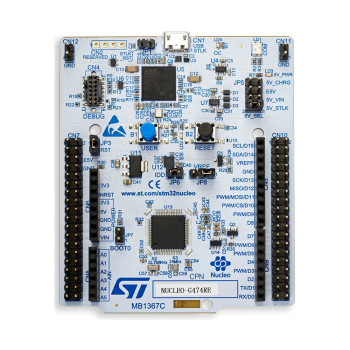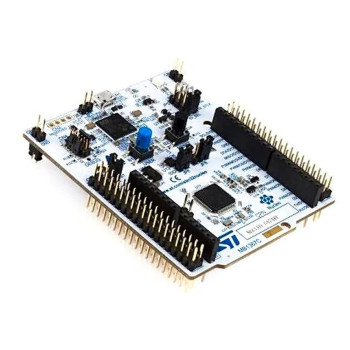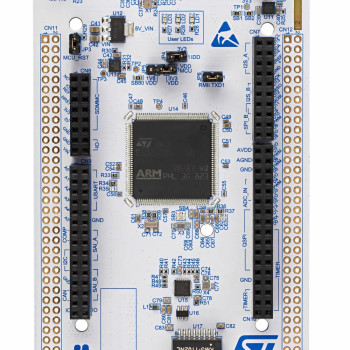
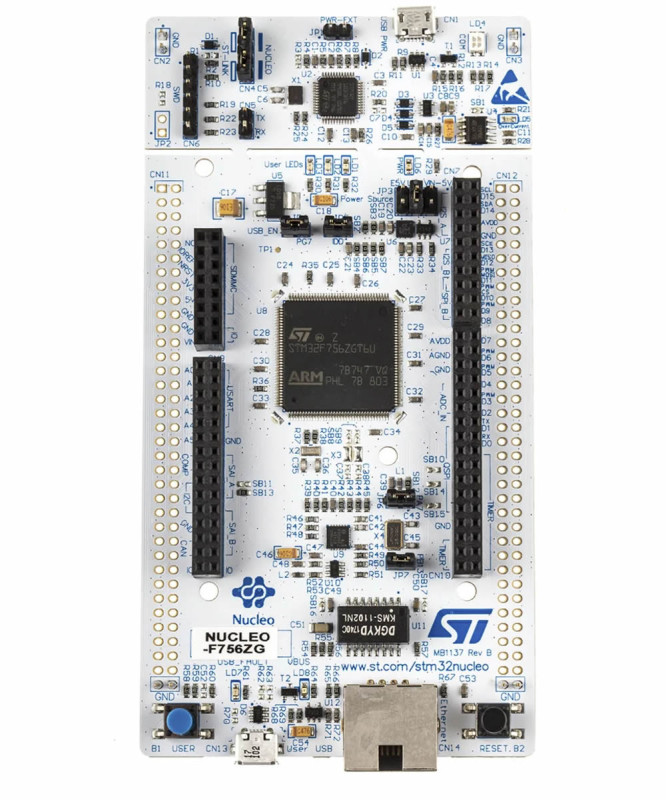
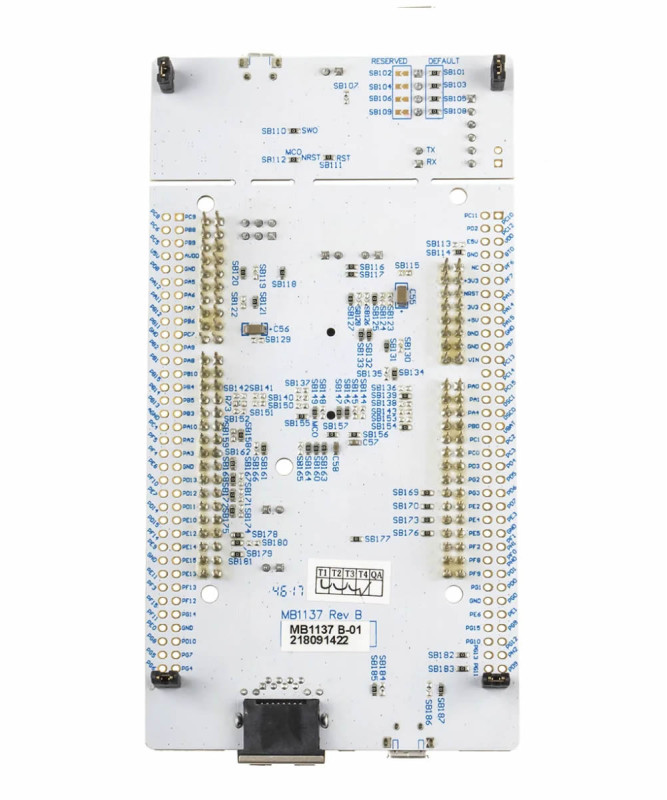
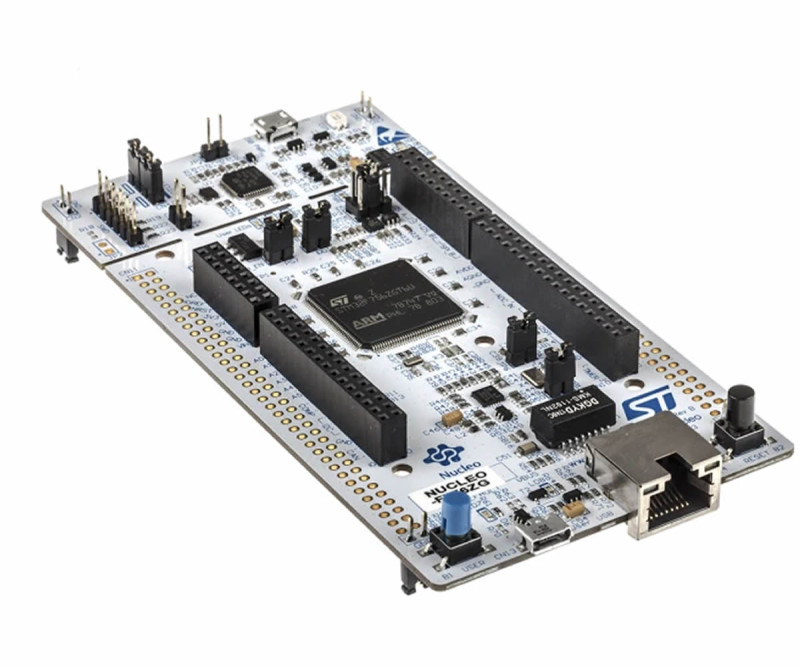
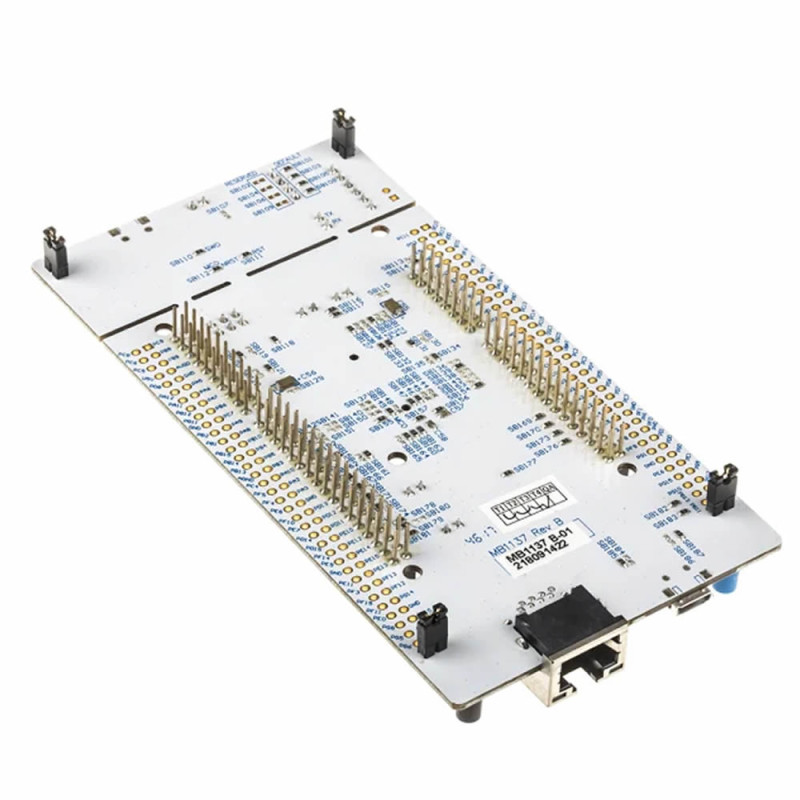
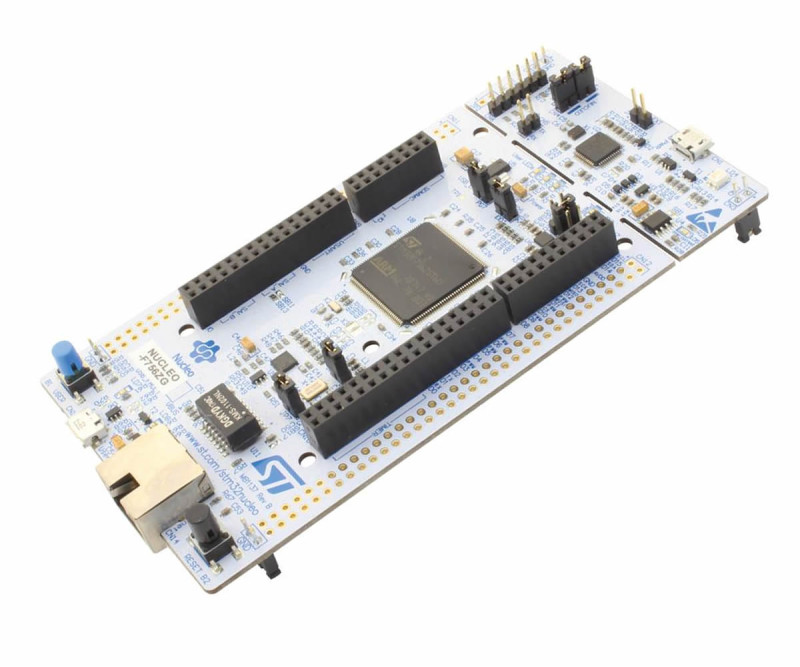
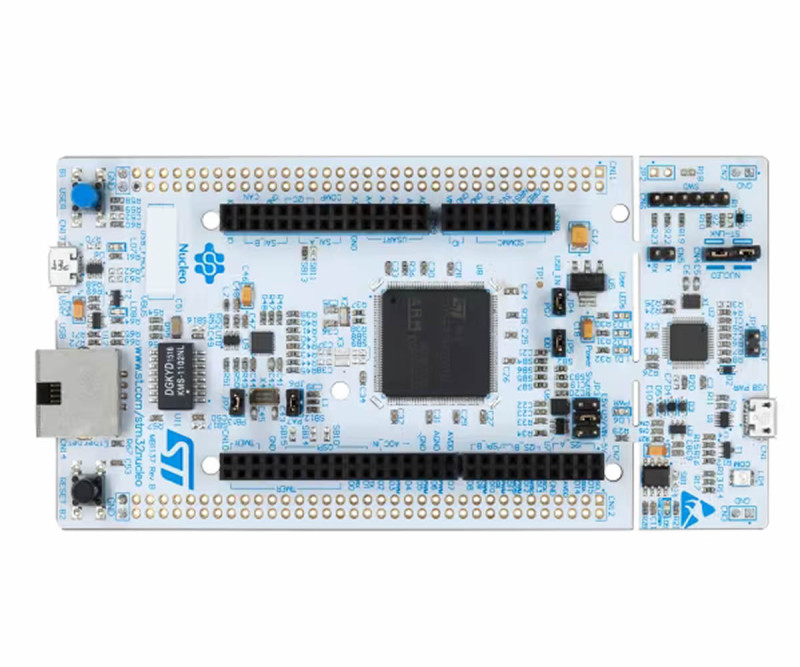
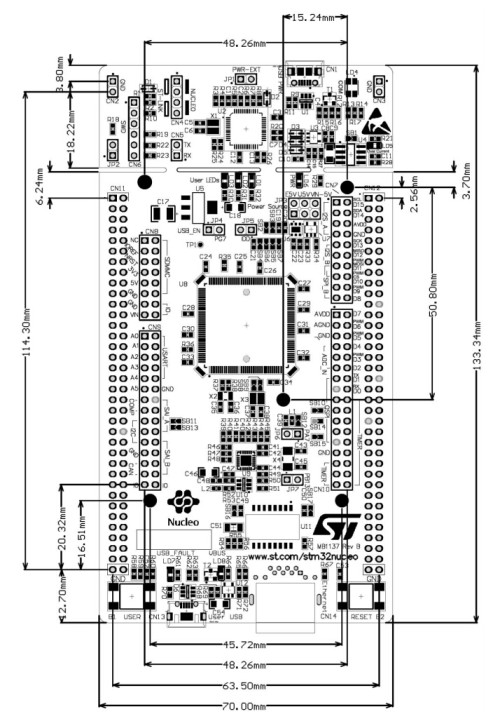
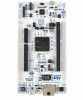
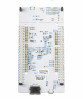
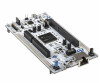
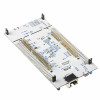
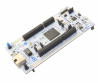
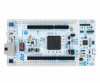
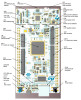
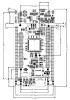
ST NUCLEO-F756ZG Nucleo Kit
STM32F756ZG Arm Cortex-M7 Mcu STM32 Geliştirme Kartı ST-LINK V2 Arduino 1 Mbyte Flash 216 MHz DSP FPU Art Accelerator HW Crypto
The STM32 Nucleo-144 board provides an affordable and flexible way for users to try out new concepts and build prototypes by choosing from the various combinations of performance and power consumption features, provided by the STM32 microcontroller. For the compatible boards, the internal or external SMPS significantly reduces power consumption in Run mode.
The ST Zio connector, which extends the ARDUINO Uno V3 connectivity, and the ST morpho headers provide an easy means of expanding the functionality of the Nucleo open development platform with a wide choice of specialized shields.
The STM32 Nucleo-144 board does not require any separate probe as it integrates the ST-LINK debugger/programmer.
The STM32 Nucleo-144 board comes with the STM32 comprehensive free software libraries and examples available with the STM32Cube MCU Package.
Features:
- Common features
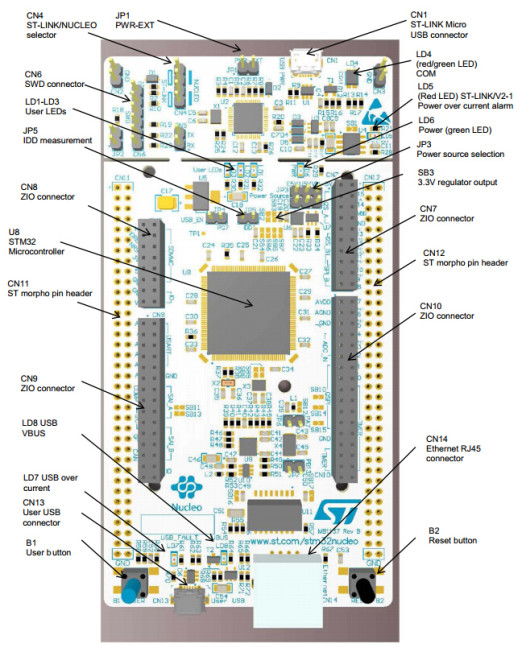
- STM32 microcontroller in an LQFP144, TFBGA225, or VFBGA264 package
- 3 user LEDs
- 1 user push-button and 1 reset push-button
- 32.768 kHz crystal oscillator
- Board connectors:
- SWD
- ST morpho expansion connector
- Flexible power-supply options: ST-LINK USB VBUS, USB connector, or external sources
- Comprehensive free software libraries and examples available with the STM32Cube MCU Package
- Support of a wide choice of Integrated Development Environments (IDEs) including IAR Embedded Workbench, MDK-ARM, and STM32CubeIDE
- Features specific to some of the boards (refer to the ordering information section of the data brief for details)
- External or internal SMPS to generate Vcore logic supply
- Ethernet compliant with IEEE-802.3-2002
- USB Device only, USB OTG full speed, or SNK/UFP (full-speed or high-speed mode)
- Board connectors:
- ARDUINO Uno V3 connector or ST Zio expansion connector including ARDUINO® Uno V3
- Camera module FPC
- MIPI20 compatible connector with trace signals
- USB with Micro-AB or USB Type-C
- Ethernet RJ45
- On-board ST-LINK (STLINK/V2-1, STLINK-V3E, or STLINK-V3EC) debugger/programmer with USB re-enumeration capability: mass storage, Virtual COM port, and debug port
STM32F756ZG
- Includes ST state-of-the-art patented technology
- Core: Arm 32-bit Cortex®-M7 CPU with FPU, adaptive real-time accelerator (ART Accelerator™) and L1-cache: 4-Kbyte data cache and 4-Kbyte instruction cache, allowing 0-wait state execution from embedded flash memory and external memories, frequency up to 216 MHz, MPU, 462 DMIPS/2.14 DMIPS/MHz (Dhrystone 2.1), and DSP instructions.
- Memories
- Up to 1 Mbyte of flash memory
- 1024 bytes of OTP memory
- SRAM: 320 Kbytes (including 64 Kbytes of data TCM RAM for critical real-time data) + 16 Kbytes of instruction TCM RAM (for critical real-time routines) + 4 Kbytes of backup SRAM (available in the lowest power modes)
- Flexible external memory controller with up to 32-bit data bus: SRAM, PSRAM, SDRAM/LPSDR SDRAM, NOR/NAND memories
- Dual mode Quad-SPI
- LCD parallel interface, 8080/6800 modes
- LCD-TFT controller up to XGA resolution with dedicated Chrom-ART Accelerator™ for enhanced graphic content creation (DMA2D)
- Clock, reset and supply management
- 1.7 V to 3.6 V application supply and I/Os
- POR, PDR, PVD and BOR
- Dedicated USB power
- 4-to-26 MHz crystal oscillator
- Internal 16 MHz factory-trimmed RC (1% accuracy)
- 32 kHz oscillator for RTC with calibration
- Internal 32 kHz RC with calibration
- Low-power
- Sleep, Stop and Standby modes
- VBAT supply for RTC, 32×32-bit backup registers + 4 Kbytes of backup SRAM
- 3×12-bit, 2.4 MSPS ADC: up to 24 channels and 7.2 MSPS in triple interleaved mode
- 2×12-bit D/A converters
- Up to 18 timers: up to thirteen 16-bit (1x low- power 16-bit timer available in Stop mode) and two 32-bit timers, each with up to 4 IC/OC/PWM or pulse counter and quadrature (incremental) encoder input. All 15 timers running up to 216 MHz. 2x watchdogs, SysTick timer
- General-purpose DMA: 16-stream DMA controller with FIFOs and burst support
- Debug mode
- SWD & JTAG interfaces
- Cortex®-M7 Trace Macrocell
- Up to 168 I/O ports with interrupt capability
- Up to 164 fast I/Os up to 108 MHz
- Up to 166 5 V-tolerant I/Os
- Up to 25 communication interfaces
- Up to 4× I2C interfaces (SMBus/PMBus)
- Up to 4x USARTs/4 UARTs (27 Mbit/s, ISO7816 interface, LIN, IrDA, modem control)
- Up to 6 SPIs (up to 50 Mbit/s), 3x with muxed simplex I2S for audio class accuracy via internal audio PLL or external clock
- 2 x SAIs (serial audio interface)
- 2 × CANs (2.0B active) and SDMMC interface
- SPDIFRX interface
- HDMI-CEC
- Advanced connectivity
- USB 2.0 full-speed device/host/OTG controller with on-chip PHY
- USB 2.0 high-speed/full-speed device/host/OTG controller with dedicated DMA, on-chip full-speed PHY and ULPI
- 10/100 Ethernet MAC with dedicated DMA: supports IEEE 1588v2 hardware, MII/RMII
- 8- to 14-bit parallel camera interface up to 54 Mbyte/s
- Cryptographic acceleration: hardware acceleration for AES 128, 192, 256, triple DES, HASH (MD5, SHA-1, SHA-2), and HMAC
- True random number generator
- CRC calculation unit
- RTC: subsecond accuracy, hardware calendar
- 96-bit unique ID
Paket içeriği:
- 1 Adet NUCLEO-F756ZG Kit
Dikkat = Paket içerisinden usb kablo çıkmaz.